
Classical VS Quantum
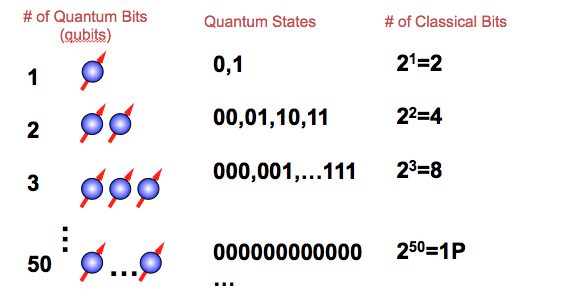
Laforest, Martin. "Introduction to Quantum Information Science & Technology." Quantum Cryptography School for Young Students. University of Waterloo, Waterloo. Aug. 2013. Lecture.
A bit, whether classical or quantum are the simplest unit of information. The difference between classical and quantum bits does not lie within the possible answers but within the possible questions. For classical bits, only a single question is permitted, is this bit one or zero. Classical bits are always in one of two states, zero or one. In contrast, a qubit is a system, which can ask many questions, but only receive two possible results. Qubits can be measure in many different ways, such as horizontally, vertically, diagonally, antidiagonally, right-circularly polarized, left circularly polarized. Unlike classical cryptography, the measurement of qubits, known as quantum measurements, can be entirely random, if measured in the wrong state. A qubit will change its value to match the result of the measurement. For example, if a qubit in a horizontally polarized state was measured in the diagonally/antidiagonally basis, the qubit will change it’s value to be either diagonal or anti-diagonally, providing a probability of 50% of getting either diagonal or anti-diagonal.