What is Light?
From the seventeenth century until the twentieth century, physicists have argued regarding the nature light. Some scientists believed light acted as a particle while others believed light acted as a wave.
Newton believed that light acted as a particle, as light seems to travel in straight lines and can travel through a vacuum. Like light, particles always travel in straight lines. Furthermore, in Newton’s time, the only type of waves that had been discovered was mechanical waves, which require a medium to move through. Since the space between the sun and the earth is a vacuum, if light was a wave, it would be unable to reach earth, as there is no medium for the wave to more through. As particles move in straight lines and can travel through a vacuum, Newton and many other scientists made the conclusion that light is a particle.
Huygens, another scientist, had a different theory on light then Newton. Huygens believed that light was a wave. Huygens focused on disproving Newton’s theory that waves were a particle. Newton based his first observation on the fact that particles and light did not diffract. However, Huygens proved that light does diffract, and therefore acts as a wave not a particle. Through the works of Francesco Grimaldi, Huygens used the information that showed the edges of shadows were not perfectly sharp. If light was a wave, the fuzziness of the edge of shadows could be attributed to diffraction of waves around the object.
Waves soon became the accepted model for light, when the particle model was proven wrong. Both Newton and Huygens were asked to explain the reason why when light hits the boundary between two media (like air and water) part of the light is transmitted and refracts, while part of it is reflected. Huygens was able to explain the results by re-creating the situation using known waves. Newton, however, was not able to properly explain the situation using the particle theory, discrediting the particle theory of light. For centuries after, the wave model was the accept mode of light. Little did scientists know that light was in fact both a particle and a wave.
The Double-Slit Experiment

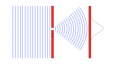
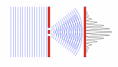
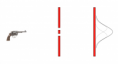
Laforest, Martin. "Introduction to Quantum Information Science & Technology." Quantum Cryptography School for Young Students. University of Waterloo, Waterloo. Aug. 2013. Lecture.
Thomas Young conducted the double slit experiment in attempts to confirm light was a wave. His initial findings concluded that light was a wave, but further tests suggested otherwise. If you fired a particle through one slit you would get a solid line. If you fired particles through two slits you would get two lines. If you let a wave go through one slit, in the middle would be the most intensity and the intensity would decrease as you move away from the slit. If you let a wave go through two slits, you would get an interference pattern. Any places where the two waves meet, the waves would cancel each other out resulting in nothing being detected where the waves interfere. Light, however, acts as both a particle and a wave. When light goes through a single slit, it acts as a particle. When light goes through a double slit, it acts as a wave. The light particle, photon, appears to go through one slit, both slits and no slits at the same time. The phenomenon of the photon holding several different positions at the same time is known as super position. Superposition is the quantum mechanical property to occupy all quantum states simultaneously. What is even more amazing is when the slit that the photon went in is measured, the system stops acting as a wave and begins acting as a particle. When the quantum state of a particle is measured, the system collapse, losing the ‘quantum’ properties, and the photon acts as a particle.