
Quantum Computers
Sadly, quantum computers will not be available for the everyday consumer for a decade or so. Most of the quantum computers physicists are working on are either theoretical or in a very controlled setting. The main components of a quantum computer are the qubits and the device that controls and programs the qubit. Some methods for changing the qubits and programming them are: nuclear magnetic resonance, radio frequency and ion traps. Nuclear magnetic resonance and ion traps are used to change the polarization of the qubits. Radio frequency is used to measure the state of the qubits in order to perform calculations and program the quantum computer.
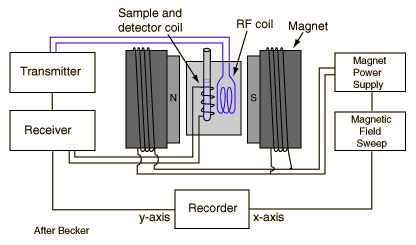
A Nuclear Magnetic Resonance (NMR) System
https://wanibesak.wordpress.com/2011/07/12/pinsip-dasar-spektroskopi-nmr/
Qubits are the main component of a quantum computer. A quantum computer used qubits in order to function. Qubits, like bits in a classical computer, allow the computer to have function, such as performing a calculation. Quantum entaglement, the correlation of states of two different qubits, provides an opportunity for the computer to read the state of the bits without collapsing the system of qubits. Through entangling two qubits, by reading one qubits, the other qubits state is known without measuring. Furthermore, quantum entanglement provides a way to manipulate a qubit without risking the chance of a collapse system. In order to do more than one calculation with a computer, the bits needed to be changeable. To change a qubit, the qubit that the qubit is entangle with can be change. Some ways to change the entangled qubit are:
1. Flipping the phase bit stored in the entangled state
2. Flipping the parity bit of the entangled state
3. Rotate the entangled basis to an untangled basis
4. Manipulate one of the qubits to change the other
This can change what measurement the other will get if measured in the same basis, If measured in a different basis, it is a 50/50 percent chance of getting the answer right.
Quantum entanglement allows the possibility of quantum computers to exist, as a method for retriving the state of the qubits is available without collapsing the system of the entire computer. In order to have a quantum computer the following five conditions must be met:
1. You must be able to initialize all of your quabits to a known state
2. You must be able to rotate individual qubits
3. You must be able to measure individual qubits
4. You must be able to preform an operation that entangles a pair of qubits
5. Your qubits must stay free of outside interference (decoherence) for as long as it takes to finish your computation
As soon as the five conditions are met, a quantum computer is created. The difficulty in maintaining each condition increases with an increasing number of qubits. The most complex quantum computer so far is made out of 128 qubits.