Why Qubits?
https://qoqms.phys.strath.ac.uk/research_qc.html
Despite advertisements by many computer companies, classical computers are not getting more powerful. The newest classical computers are only faster than older classical computers.
Computers were improved by decreasing the size of the parts. Smaller parts have less inertia and operate at a faster speed with less energy. Furthermore, more parts can be fit into a given space. Every component got smaller from gears to the circuit to the transistor. Towards the 1970’s, the integrated circuit components had reached the size of 3 micrometers. Engineers and scientists became worried, as there is a limit of how small the components can be, and they were reaching the limit. Some form of technology needed to be discovered to increase the power of the computer instead of the speed, as the speed of computers was reaching a limit. The answer was quantum.
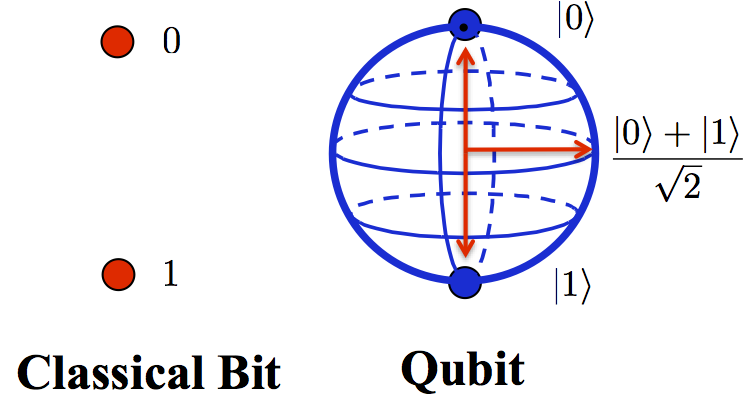
Qubits unlike bits had the possibility to be in superposition, a combination of both the state 1 and 0. The entire machine is a superposition of all possible memory state. The possibilities of computational power is endless, as with each qubit added, the processing power increases exponentially. Quantum computers can try every possible permutation in one step compared to classical computers which require a step for each possible permutation.
Cool Experiments on Qubits:
Quantum Entanglement Applied: Data Teleportation
In a new experiment, scientists have successfully transferred information from one qubit to another through a solid-state system. Quantum teleportation, derived on the basis of quantum entanglement, provides the ability to transfer information without the use of an information carrier such as electromagnetic waves. Two qubits were entangled, each qubit residing on one end of a computer chip. Data was writen onto the sender qubit, and resulted in the information being transfered to the other entangled qubit, at a distance of 6 mm. While 6mm is not a large distance, in the eyes of quantum physicists, 6mm is a big step in technology, from previous experiments which required the distance to be a thousand times smaller.
The Photoelectric Effect
The Photoelectric Effect is one of the experiments that helped confirm lights dual nature as both a particle and a wave as well as the birth of quantum mechanics. When a surface is exposed to a certain amount of energetic electromagnetic energy, light will be absorbed and electrons will be emitted. Einstein explained this phenoneum, by hypothisizing that light was made of particles known as photons. Then energy of a quantum of photons was represented by the frequency multiplied by a constant, later discovered to be Planck's Constant. If the energy of a photon was over a certain threshold, the photon could eject the electron. The photoelectric effect shows that light is also a particle. Combined with the double-slit experiment, the conclusion can be made that light acts as both a particle and a wave. Thus quantum mechanics was born.